
Author
Rezoyan Mahfuz
Publish Date
April 10, 2026
Latest Update
April 15, 2026
3D Modeling, a dynamic and creative field, has gained immense prominence in industries like gaming, architecture, animation, and product design. It offers the power to bring intricate designs, characters, and environments to life with precision and detail. However, the question often arises: Is 3D Modeling hard to learn?
3D Modeling’s difficulty varies with individual aptitude and dedication. While it demands spatial thinking and software proficiency, it offers creative control and precision. With consistent practice and learning resources, mastering 3D Modeling can be a rewarding journey for those passionate about this dynamic field.
In our comprehensive blog post, we will explore the world of 3D Modeling, shedding light on the learning process, potential challenges, and the rewarding journey that awaits aspiring 3D modelers.
3D Modeling is a creative process that involves using specialized software tools to design and construct digital representations of objects, characters, environments, or structures in three-dimensional space. These 3D models can depict real-world items or entirely fictional creations.
The 3D modeling process typically begins with the creation of a basic three-dimensional structure or wireframe, often referred to as a “mesh.” Artists or designers can then manipulate the points, edges, and faces of this mesh to shape and refine the model, adding details, textures, and colors to achieve the desired result.
3D Modeling finds applications in various fields, including video game development, film and animation production, architecture, engineering, and product design. Mastering 3D Modeling can be a complex and time-consuming endeavor, often requiring continuous practice and skill development.
The difficulty of learning 3D Modeling varies from person to person, but it is generally considered easy to learn. In many ways, 3D Modeling can be less challenging than 2D art, which often requires drawing skills. However, mastery of any skill depends on an individual’s dedication and practice.
Once you become familiar with the 3D modeling software, you may find it enjoyable and rewarding. Manipulating a 3D model typically involves working with vertices (points) to move and shape the object. There can be multiple ways to achieve this, and the approach you choose often depends on your creativity and self-awareness. Some may discover more techniques than others.
While learning 3D Modeling may take time, the availability of software and tutorials can accelerate the learning process. Working with an experienced instructor can be particularly beneficial, as they can guide you through the learning curve, offer assistance when you encounter challenges, and ensure you are on the right track.

3D Modeling is a versatile and fascinating field, allowing artists, designers, and engineers to create lifelike three-dimensional representations of objects, characters, environments, and more. While it offers a wealth of creative possibilities, 3D Modeling can also be challenging. Here are some key factors that contribute to the complexity of 3D Modeling:
One of the primary challenges in 3D Modeling is mastering the technical aspects of the software and tools. Most 3D modeling applications are feature-rich and complex, requiring users to become proficient in various functions, such as Modeling, texturing, lighting, and rendering. Learning to navigate these tools efficiently can be daunting, especially for beginners.
Unlike traditional 2D art, 3D Modeling involves thinking in three dimensions. Artists must understand how objects exist in space, including their volume, depth, and spatial relationships. This spatial thinking can be challenging, as it requires visualizing and manipulating objects from multiple angles.
Successful 3D Modeling often demands a strong foundation in traditional art skills, such as drawing, design, and color theory. Artists need to apply these skills to create visually appealing and realistic 3D models. This blending of artistry and technology can be demanding, particularly for those who need more prior artistic experience.
3D Modeling often involves intricate details, whether it’s the texture of a character’s skin, the realistic lighting of a scene, or the precision of mechanical components. Achieving these details requires a high level of precision and meticulous attention to small elements, which can be time-consuming and demanding.
3D Modeling frequently presents unexpected challenges. Artists and designers must find creative solutions when facing issues such as mesh deformities, UV mapping problems, or rendering errors. Problem-solving is an integral part of the 3D modeling process and demands a strong analytical mindset.
Achieving realism and aesthetically pleasing results can be a significant challenge. Artists must consider factors like lighting, material properties, and environmental effects to create convincing 3D scenes. Striking the balance between realism and artistic interpretation can take time and effort.
More complex models, especially those used in video games, movies, or architectural design, require intricate detailing and optimization. Creating such models demands a higher level of skill and experience.
The field of 3D Modeling is continuously evolving, with software updates and new techniques emerging regularly. As a result, 3D modelers must commit to lifelong learning to stay current in the industry.
In professional settings, 3D modelers often work within multidisciplinary teams. Effective collaboration with professionals from different backgrounds, such as animators, engineers, or architects, can be challenging due to differing expectations and terminologies.
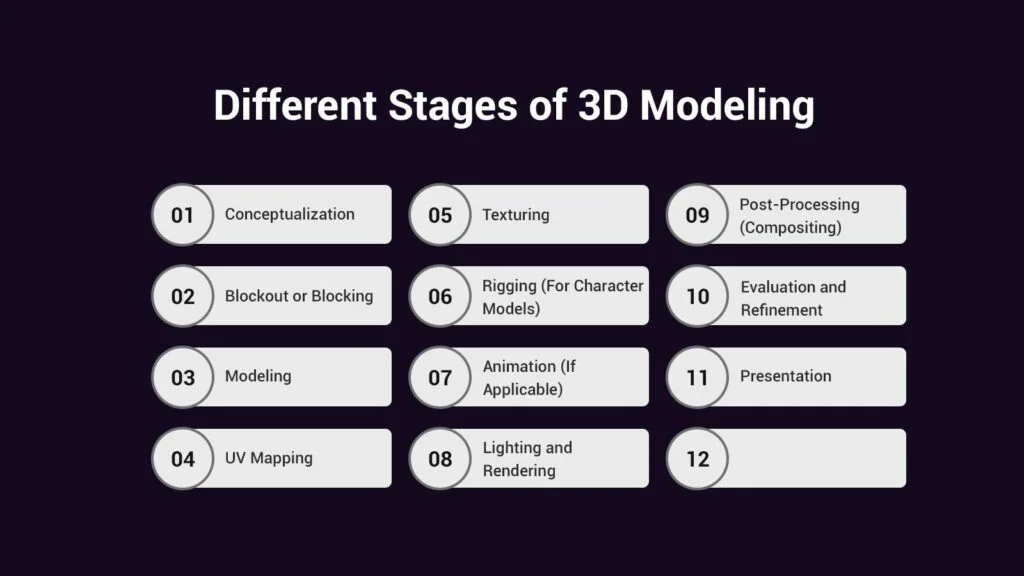
3D Modeling is a multi-stage process that involves creating three-dimensional digital representations of objects, characters, environments, or concepts. These stages are essential for achieving a final, detailed 3D model. Here are the typical stages of 3D Modeling:
This initial stage involves defining the project’s objectives and conceptualizing the 3D model. Artists and designers plan what they want to create, considering factors like style, purpose, and intended audience. Sketches, mood boards, or written descriptions may be used to visualize the concept.
Blockout is the phase where the 3D model’s basic form is created using primitive shapes like cubes, spheres, and cylinders. It serves as a foundation for the more detailed Modeling to follow. Blockout helps artists establish proportions, scale, and overall composition.
In this stage, artists create the 3D model’s detailed geometry. They add vertices, edges, and faces to build the object’s form, taking into account its complexity. Modeling can involve various techniques, such as extrusion, subdivision surface modeling, or sculpting.
UV mapping is the process of unwrapping the 3D model’s surface geometry to create a 2D texture map. This map helps apply textures, images, or materials to the 3D model accurately. UV mapping requires careful planning to minimize texture distortion.
Texturing involves applying materials, colors, textures, and surface properties to the 3D model. Artists create or import textures to enhance the model’s visual realism. This stage can include painting textures directly onto the model or using image editing software.
In character modeling, rigging is the process of adding a digital skeleton to the model. This allows for animation by defining how different parts of the character move in response to controls. Rigging includes setting up bones, joints, and skinning.
In cases where animation is required, this stage involves creating movement and actions for the 3D model. Animators use keyframes, rigs, and various animation techniques to bring the model to life.
Lighting is crucial to achieving a realistic and visually appealing 3D model. Artists set up virtual lights and adjust their properties to illuminate the scene correctly. The final rendering stage involves capturing the 3D model as an image or animation, considering factors like resolution and quality.
After rendering, post-processing may be applied to enhance the image or animation. This can involve color correction, adding visual effects, or compositing multiple layers to achieve the desired result.
Artists review the 3D model to assess its quality and ensure it meets the project’s goals. Refinements, adjustments, and optimizations are made as necessary to enhance the final output.
The finished 3D model may be presented in various forms, such as still images, animations, interactive 3D experiences, or as part of a larger project, like a video game or architectural visualization.
Creating 3D models requires the use of specialized software programs that provide the tools and features necessary for Modeling, texturing, lighting, and rendering. The choice of software depends on the specific needs and preferences of the artist or designer. Here are some widely used software programs for 3D Modeling:
Autodesk Maya is a comprehensive 3D animation and modeling software used in various industries, including film, video games, and visual effects. It offers a wide range of tools for Modeling, animation, rigging, and rendering.
3ds Max is another Autodesk product favored for its modeling and rendering capabilities. It is widely used in architectural visualization, product design, and game development.
Blender is a powerful open-source 3D modeling and animation software. It provides a full suite of tools for Modeling, sculpting, texturing, rigging, animation, and rendering. Blender’s extensive community and frequent updates make it a popular choice.
ZBrush is renowned for its digital sculpting and texturing capabilities. It is often used for creating highly detailed character and creature models. ZBrush offers features like dynamic tessellation and advanced sculpting brushes.
Cinema 4D is popular in the motion graphics and visualization industry. It offers a user-friendly interface and comprehensive tools for 3D Modeling, animation, lighting, and rendering.
Houdini is known for its procedural modeling and animation features. It is commonly used in the creation of special effects and simulations for film and games.
Modo is a 3D modeling and rendering software known for its ease of use. It offers a range of modeling tools and is suitable for both beginners and professionals.
Rhino is a 3D modeling software often used in industrial design and architecture. It specializes in NURBS modeling, making it ideal for creating complex curved surfaces and precise models.
SketchUp is known for its simplicity and suitability for architectural Modeling. It offers easy-to-use tools for creating 3D models of buildings and interiors.
SolidWorks is an industry standard for 3D CAD modeling and is primarily used in engineering and product design. It is suitable for creating mechanical and parametric models.
Tinkercad is a beginner-friendly web-based 3D modeling application. It’s often used in education and for quick and simple 3D model creation.
Mudbox, also an Autodesk product, focuses on digital sculpting and texture painting. It’s used for character and creature modeling in the entertainment industry.
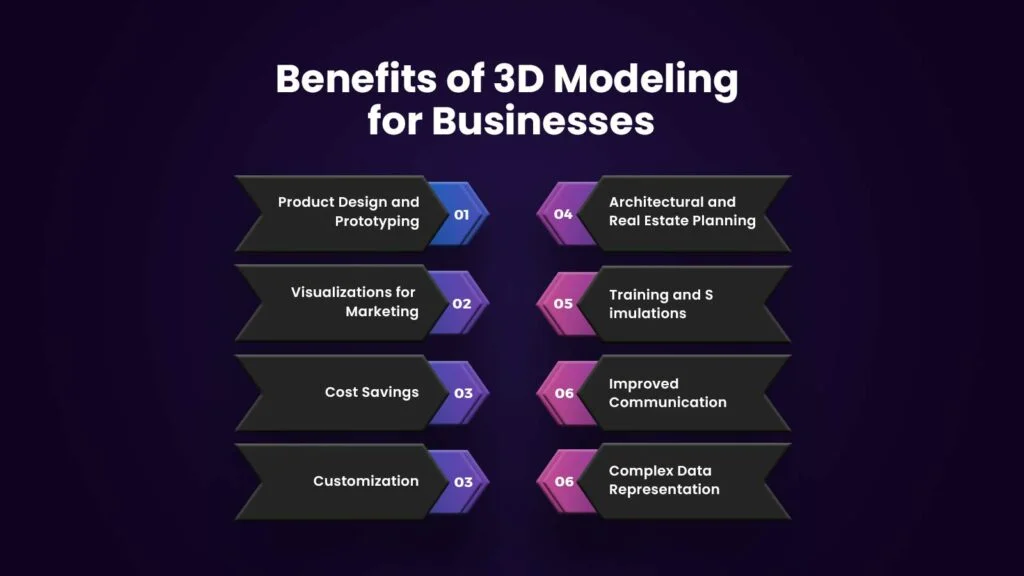
3D Modeling offers numerous advantages to businesses across various industries. Whether it’s for product design, marketing, or architectural planning, here are the key benefits of integrating 3D Modeling into business operations:
A career in 3D Modeling is both creatively fulfilling and financially rewarding. As of September 2023, the average salary for a 3D modeler in the United States is approximately $56,468. However, salaries can range from $49,400 to $66,249, with variances based on factors such as experience, location, industry, and specific job responsibilities.
3D modelers play a crucial role in a wide range of industries, including film, video games, architecture, product design, engineering, and more. They are responsible for creating detailed three-dimensional representations of objects, characters, environments, and concepts. This work requires a combination of technical proficiency, artistic skills, and spatial thinking.
As a 3D modeler, you have the opportunity to contribute to the development of video games, the production of movies and animations, the design of architectural structures, and the creation of product prototypes. Your work can influence the visual and creative aspects of various projects.
3D Modeling can be challenging for beginners due to the technical aspects and spatial thinking involved. However, with practice and the right resources, beginners can make significant progress.
Essential skills include spatial awareness, attention to detail, artistic skills, and a good understanding of the chosen 3D modeling software.
The time it takes to become proficient in 3D Modeling varies. It depends on individual dedication and the complexity of the projects. Continuous practice is key to improvement.
3D Modeling and 2D drawing have different challenges. Some may find 3D Modeling easier due to the precision it offers, while others prefer the creative freedom of 2D drawing.
While self-learning is possible, formal training or online courses can expedite the learning process and provide guidance, especially for those aiming to pursue 3D Modeling professionally.
The most challenging aspects often include
Yes, 3D Modeling can be highly rewarding. It offers the ability to create realistic or imaginative 3D models for various applications, from video games and movies to product design and architecture.
Whether 3D Modeling is easier than drawing or vice versa depends on an individual’s preferences and skills. Both have their unique challenges and advantages. 3D Modeling requires technical proficiency in software and a spatial understanding of three-dimensional objects, offering precision and control. Drawing, on the other hand, demands knowledge of design principles, color theory, and proportions, allowing for more artistic and natural creations without the reliance on computer tools.
Some may find 3D Modeling easier due to the digital tools and accuracy it provides, while others may prefer the creative freedom of drawing by hand. In the end, it’s a matter of personal inclination and the specific goals of the artist or designer.
Explore more insights, tips, and expert guides to help you create better designs and make smarter decisions.

While small companies might get help from one platform, big companies will choose another. Need some of the best e-commerce platforms for SEO? Read to know!

Many SEO specialists struggle to choose between Screaming Frog vs Ahrefs because both offer different features. Wondering which one is better? Read here!

0+Happy clients served
Why is graphic design important? Graphic design is important for effective communication, brand recognition, and captivating visuals that engage audiences.